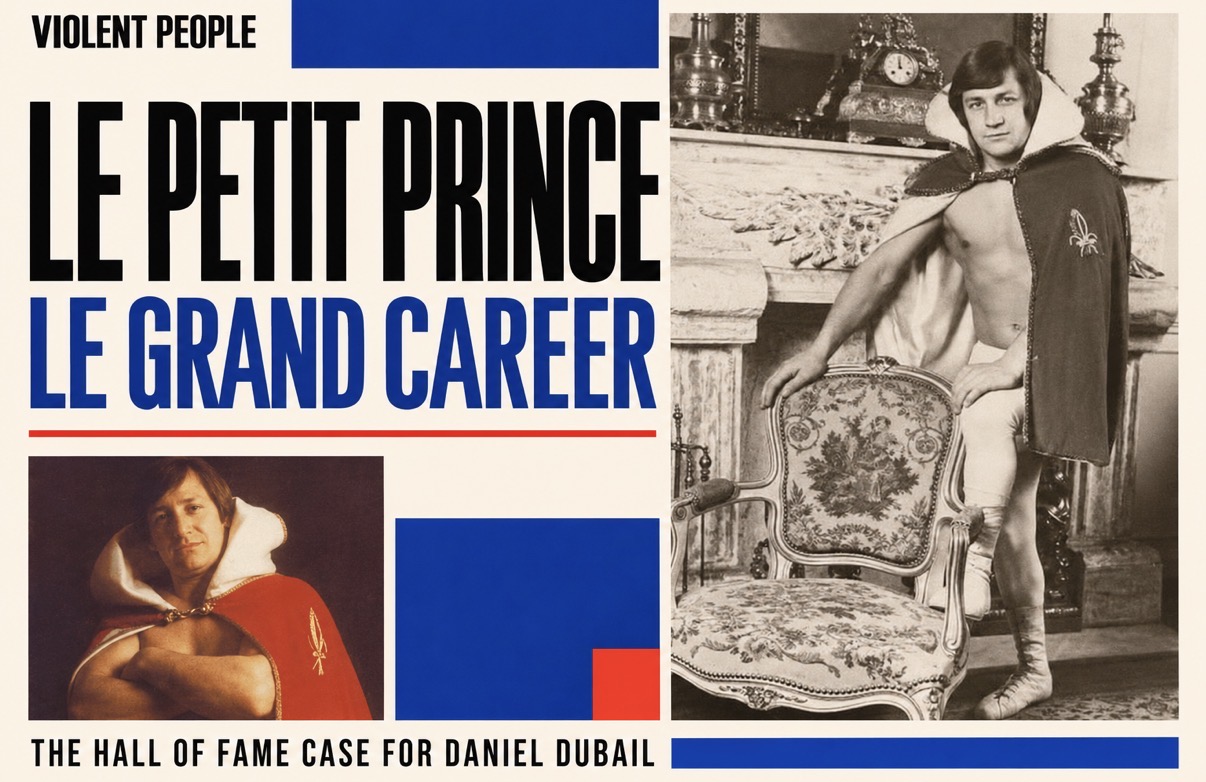
Le Petit Prince, Le Grand Career: The Hall of Fame Case for Daniel Dubail
September 30, 1967. Michel Saulnier tries his best to slow down Le Petit Prince. He works headlocks and hammerlocks, trying to secure a man who seems incapable of being trapped. Prince keeps flipping and twisting his way out. Saulnier gets hold of him again. Prince finds another way to escape.
Then Prince gets meaner. He scrapes a heel across Saulnier’s chin and lands a sick spinning kick. By the time they are choking each other around the referee, the little fellow who entered wearing glasses and a cape has become considerably less princely and, honestly, less petit. If you’re meeting Daniel Dubail for the first time, this is a pretty good introduction. He can flip out of whatever hold you put him in, and eventually he might decide to kick the shit out of you.[1a]
People watching him in 1966 noticed it, too. Writing in “New Faces on the Belgian Scene,” Walt Van Uytfangh described him as “a clean and scientific wrestler” who could “hold his own when the going gets rough.”[5a] Saulnier could confirm both parts.

Last year, I tried and failed to finish an argument for Dory Dixon’s inclusion in the Wrestling Observer Hall of Fame. He, of course, then got voted in. It may be bad luck that I’m getting this case for Dubail published before the results are in. If he misses out, I apologize for interfering with a system that was clearly working.
Prince could escape a hold, piss off an opponent, take a beating, and produce some of the most spectacular high-flying you’ve ever seen. Sometimes he could get through most of that in the same sequence. The footage is impressive enough when you encounter it as a clip. Watching somebody try to keep up with him for an entire match gives you considerably more to appreciate.
Watching him, I get the same feeling I get watching early Tiger Mask or Rey Mysterio. How the hell is somebody already doing this? Prince was doing it on French television in the 1960s. That alone would get me interested. Finding out he could keep being this good for years is what makes me want to vote for him.
Before going any further, I need to thank Phil Lions. He is an invaluable resource to the wrestling history community, and this piece wouldn’t exist without his research. His appearance on The Ballot is essential listening for anybody interested in Prince. Lions describes a star who could headline smaller regional shows, but who generally wasn’t the leading attraction on the major Paris cards. The strongest part of his case is how good he was, and how long he stayed that good.[2a] Jonathan Snowden’s Tiger Jeet Singh piece for POST Wrestling gave me the idea of approaching a Hall of Fame case through a researched biography. I also need to thank Matt D for his YouTube channel and his invaluable analysis.
Daniel Dubail was born in Audincourt, near the Swiss border, on September 25, 1943. The son of a blacksmith, he learned gymnastics at La Sportive Audincourt, which still lists him among its former pupils.[3a] It’s easy to see what he took from those lessons.
Lions describes Olympic ambitions interrupted by injury. A profile in Jean Corne’s 1974 book, La Vérité sur le catch, places him at the French gymnastics championships in the cadet category. That doesn’t mean that he would’ve made an Olympic team, but it gives us something more concrete than saying he was just a naturally athletic little dude.[2b][4a]
A boxing uncle encouraged his interest in the ring. He began training at fourteen, continued in amateur wrestling, and served in the air force. In Corne’s account, Dubail stressed how much preparation professional wrestling required. He’d already acquired a cauliflower ear within his first two months. A fairly unpleasant introduction to the business.[4b]
His brother Jean-Pierre was there with him in the beginning. According to the family interviews Lions recounts, the brothers volunteered to face wrestlers taking challenges at fairs. They kept getting turned down because they were too small. Eventually, an organizer let them wrestle an exhibition against each other. If nobody would let them fight the professionals, at least they could fight each other in front of people.[2c]
By the time Paris became interested, Dubail had been wrestling for years. In a contemporary profile, “New Faces on the Belgian Scene,” Walt Van Uytfangh described him as having spent five years working as an amateur or semiprofessional in provincial France before turning professional in December 1965.[5b] Lions places the move onto the established pro circuit that fall.[2d] His precise starting date is still unsettled.
Robert Lageat, the manager credited with discovering him, brought him into the Paris circuit. There, Michel Saulnier helped train him at the wrestling room on the rue des Martyrs.[6a] Saulnier would spend plenty of time on television demonstrating both what he had taught Dubail and how irritating it could be to wrestle him.
His path took him from gymnastics and amateur wrestling through years of exhibitions with his brother, then professional training in Paris. He had teachers and opponents, and France already had athletic wrestlers. Lions points to René Ben Chemoul as an earlier example, while distinguishing his acrobatics from what Prince was doing. He also suggests those years at the fairs gave Prince room to develop before a conventional school could give his style polish.[2e]
Corne recognized the individuality of it in 1974, describing a “very personal and also very spectacular technique,” in the English rendering reproduced by Lions.[4c] The description still fits. You can follow the ingredients that went into his wrestling and still be surprised by what came out.
Dubail initially worked as Albéric d’Éricourt. “Le Petit Prince” appeared alongside it and eventually became the name most people remember. Corne’s profile credits commentator Roger Couderc with giving him the nickname in 1966.[4d][6b]
Lions identifies January 23, 1966 as his probable French television debut, with the qualification “as best as I can tell.” The more familiar footage of Prince training with a young André the Giant comes from a regional Paris news report the following month. André was still Jean Ferré. In Lions’s chronology, the demonstration followed Prince’s January television debut.[7a]
Albéric d’Éricourt was still being used during his May 22, 1966 television match against Bobby Genele.[6c]
He was getting a lot of television attention for somebody so new. Lions identifies four Prince appearances among thirty-two wrestling broadcasts in 1966. Those broadcasts were divided among competing booking offices, and only six can be firmly assigned to Prince’s office. If two of the unassigned broadcasts also belonged to it, Prince would still have appeared in half its television opportunities that year.[2f]
Four appearances doesn’t sound like much until you realize how little television there was to go around. I can’t tell you how many people turned on their television specifically to see him. But his office had limited chances to reach a national audience, and Prince kept getting picked.
The Genele match makes Prince’s appeal fairly easy to understand. Prince shines and makes Genele look foolish. Genele responds by beating on him.[6d] A fairly understandable response, but I’m still rooting for the lil dude doing the flips.
Saulnier gave him more to work with. Their televised draws in 1967, 1968, and 1969 put Prince against a man recognized as world lightweight champion and kept him on equal terms. Lions reads those results as a way to establish that Prince could compete with the champion without needing to put the belt on him.[2g]
Foreign promoters noticed him early, too. A Swiss record places Prince at Zurich’s Hallenstadion against Mike Falemp on February 15, 1966, and Michele Lanza on March 2, 1967. Lions also identifies early work in Belgium and later appearances in Spain and Britain.[2h][8a]
In December 1970, Prince brought his act to British television and the Royal Albert Hall. On December 15, he wrestled Robby Baron at Croydon in a match recorded for ITV. It aired on December 23, with Prince winning by one fall to zero. Between the recording and the broadcast, he appeared at the Royal Albert Hall: the December 16 program bills him against Zoltan Boscik.[9a]
In the September 1972 issue of The Wrestler, John Rackham singled him out in “These Fantastic Frenchmen.” Rackham described Prince embarrassing and beating opponents more than two stone heavier. I assume a stone is a lot. No way to know for sure. Recalling his British visit, Rackham praised his “great athletic ability and his cavalier treatment of some well-known British matmen.”[10a]
It’s useful to have somebody saying this while Prince was still working. Admiration for him didn’t begin when the Segunda Caida gang started posting about French catch. He had already impressed people willing to book him abroad, put him on British television, and write about how good he was.
Most of the career, though, happened in France. And the French footage gives us plenty.
On February 22, 1971, Prince teams with Francis Louis against Daniel Noced and Jacky Richard. The early exchanges go well for Prince and Louis. Then the beating starts. Noced traps Prince in a hammerlock and drives his head into the canvas.[11a]
The match gets ugly. They spill outside, spectators become involved, and Prince is bleeding. With Richard out of the action, Prince insists on continuing against Noced rather than leaving it to Louis. He keeps going until he collapses and a towel comes in from ringside.[12a]
I think this is where his babyface case becomes especially strong. The flips draw you in, but watching Noced take away his ability to do any of them and Prince still gives you a reason to get invested. His determination to keep fighting makes the finish worse. There is a lot more happening here than waiting to applaud the next escape or flip.
HANDWERK questions the consistency of his arm selling, which is fair to bring up here.[11b] You can make a case for a great wrestler without pretending he never forgot which arm was supposed to hurt.
Noced is back in the match dated October 12, 1974, teaming with Guy Renault against Prince and Alan Mitchell. Matt D’s Segunda Caida review points out how well Mitchell’s joint manipulation complements Prince’s acrobatics, with Noced able to accommodate Prince’s movement and then shut him down.[13a] Everybody has something useful to contribute, and Prince gets to work beside somebody whose spots look different from his own.
There is also a guest appearance by Jean Robic, the former Tour de France winner. After the referee gets knocked down, Robic comes in to count a fall.[13b] Apparently, one of the benefits of winning the Tour de France is that you might eventually get to finish refereeing a Le Petit Prince match. Kinda makes the Lance Armstrong stuff make more sense.
Albert Sanniez gives Prince another excellent opponent on October 15, 1977. He can keep up with the exchanges, take huge bumps off the monkey flips, and cheat often enough to make you want to see another one. He’s good enough to make it all look spectacular and enough of a bastard to make you enjoy seeing it happen to him.[14a]
There was obviously a lot more of that work than the matches we can watch. Lions cites a 1977 interview in which Prince said he was wrestling about 150 matches a year.[2i]
Claude Roca, when discussing Prince, remembered all the travel. Speaking to Le Parisien in October 2005, he said they had teamed for twelve years, worked three or four galas a week, and put 100,000 kilometres on the clock in a year. Brittany and the North were particularly good wrestling territories. Somewhere in all that travel, there was also an appearance before Grace Kelly and Prince Rainier in Monaco.[15a]
Roca said Prince recruited him. An amateur wrestling champion, Roca learned professional wrestling at the rue des Martyrs training room.[15b]
The local records put a few stops back into those years on the road. A Fontenay-aux-Roses archival feature documents a 1972 appearance at the Gymnase du Parc. A Teloché municipal retrospective remembers Prince, L’Ange Blanc, and women’s wrestling on a 1975 show at the Étangs des Chères. [16a]
Clamart’s June 1979 municipal bulletin advertised Prince against Sanniez at the Stade Hunebelle gymnasium on June 19. Roca versus Bob Remy and Walter Bordes versus Antonio Tejero were also on the card. TF1’s Daniel Pautrat was advertised as a presenter. Twenty francs got you in; children ten and under were free.[17a]
These were the evenings between television appearances: familiar opponents, a local gym, twenty francs at the door, then another town.
By then, French wrestling had been declining in popularity for years. Lions places the beginning of that decline near the end of the 1960s, only a few years after Prince entered the business. The shows continued, but in a smaller and less prominent wrestling world.[2j] Most of his regular career happened during that decline.
On the August 18, 1980 broadcast, Prince and Roca face Remy and Anton Tejero. Prince is thirty-six. Tejero attacks before the bell and knocks off his glasses.[18a]
Roca has a handstand escape from a headlock. Prince spends much of the match getting punished. Remy takes the first fall after a missed tag, Roca equalizes with an airplane spin, and Prince eventually pins Tejero with a sunset flip.[18b] Prince needs his partner’s help, gets it, and still gets to be the man who wins the match.
There is some comedy with the referee, too. Remy and Tejero help make the ridiculous stuff happen while remaining men you want to see get their asses kicked.[18c]
In an early-1980s tag with Gérard Bouvet against Tejero and Sanniez, people want Prince’s autograph. He stops to greet Couderc.[19a] He’s been doing this for years, and people are still happy to see him.
And he can still go. Lions traces the quality from 1966 through the early 1980s and says a brief television segment from 1986 showed Prince retaining his speed.[2k] By then, people had been watching him do this for twenty years. He could still make it worth their time.
In 1989, a car accident badly broke his leg. He was forty-five or forty-six, with roughly twenty-four years of professional wrestling behind him. Lions describes a few matches in the 1990s and a one-off legends appearance in 2001, but identifies the accident as the end of his active career.[2l]
The years afterward were difficult. Lions recounts financial problems, unemployment, occasional jobs, and cancer treatment. Prince eventually left for Thailand, hoping to open a wrestling school. He left much of his memorabilia with his daughter Nathalie.[2m]
Daniel Robert Maxime Dubail died in Thailand on December 17, 2005, aged sixty-two, according to the INSEE-derived death index. That differs by one day from several older wrestling biographies.[20a]
Nathalie helped preserve what he left behind. The surviving matches now reach people who never had the opportunity to see him on television or in a local gymnasium. Somebody encounters a clip, wonders how the hell he did that, and hopefully finds the full match. There are worse ways to spend an evening.
There are also fair objections to putting him in the Hall of Fame. The records assembled here don’t establish him as a major national draw. His documented foreign work is limited, and the resemblance to later wrestlers doesn’t prove that the wrestlers learned anything from him. I can’t turn the Clamart advertisement into a gate figure. A shrinking French market doesn’t entitle him to the crowds he MIGHT have drawn somewhere else.
I would vote for him because he still makes me reconsider what was possible in his time. I don’t need to invent a match in Japan or a gate in Mexico to make that case. We have the work and the work is enough.
What keeps bringing me back is how much there is to enjoy after the first surprise wears off. Once you know Prince can get out of the hold, you can watch Saulnier trying to stop him. Once you’ve seen him fly around, you can watch Noced make that impossible. You can watch Roca give him another chance, or Sanniez give him another reason to get pissed off. Prince makes each of these look and feel utterly unique.
At the risk of repeating myself there’s just nothing like him. That has to count for something and it deserve to be not just recognized but preserved.
Le Petit Prince belongs in the Hall of Fame. He was a unicorn. The Hall of Fame should have a place for those. So, hopefully he’s elected into the Wrestling Observer Hall of Fame and then I’ll nominate him for the more prestigious Violent People Hall of Fame. I think being this good, this unusual, for this long is enough.
Sources
- September 30, 1967, Michel Saulnier match. Phil Schneider and Eric Ritz, “La Petit Prince Is Having the Prime Time of His Life,” Segunda Caida. Return to article: 1a
- Phil Lions Podcast Appearance The Ballot: Le Petit Prince with Phil Lions, Count Out! Wrestling Podcast Network. Return to article: 2a · 2b · 2c · 2d · 2e · 2f · 2g · 2h · 2i · 2j · 2k · 2l · 2m
- Birthplace, family background, gymnastics club. La Sportive Audincourt, official club history; Serge Lacroix, “Le Petit Prince, l’Audincourtois devenu star du catch,” L’Est Républicain, August 9, 2023; birth date also in endnote 20. Return to article: 3a
- 1974 near-contemporary biographical profile. Jean Corne, La Vérité sur le catch (1974), profile of Le Petit Prince, available in translation/reproduction through Phil Lions’s post in the French Catch thread, Pro Wrestling Only, page 33. Return to article: 4a · 4b · 4c · 4d
- Professional starting point and provincial apprenticeship. Walt Van Uytfangh, “New Faces on the Belgian Scene,” surviving clipping direct scan. Return to article: 5a · 5b
- Paris training and Bobby Genele footage. French Catch thread, Pro Wrestling Only, page 9. Return to article: 6a · 6b · 6c · 6d
- Probable television debut and André demonstration. Phil Lions, January 23, 2026 postReturn to article: 7a
- Switzerland. Wrestling-Titles.com, Ron G. historical Swiss results archive (PDF). Entries cited: Zurich, February 15, 1966; March 2, 1967. Return to article: 8a
- Britain, December 1970. Royal Albert Hall archive, December 16, 1970 wrestling programme, RAHE/1/1970/185; ITV Wrestling, 1970 results. Return to article: 9a
- Contemporary British assessment. John Rackham, “These Fantastic Frenchmen,” The Wrestler, September 1972, printed page 11, available in the scanned issue on Sixties City. Return to article: 10a
- February 22, 1971 tag, structure and critical reservation. HANDWERK Reviews, Prince/Francis Louis versus Daniel Noced/Jacky Richard. Return to article: 11a · 11b
- 1971 tag conclusion. SAMS’s Ragtag 1970s Yearbooks, Pro Wrestling Only, page 2. Return to article: 12a
- October 12, 1974 tag. Segunda Caida, “Prince! Mitchell! Noced! Renault! Schmid! James!”. Return to article: 13a · 13b
- October 15, 1977, Albert Sanniez match. Segunda Caida, “Tuesday Is French Catch Day: Le Big Chief! di Santo! Zarak! Lecomte! Le Petit Prince! Sanniez!”. Return to article: 14a
- Claude Roca’s testimony. “J’ai fait équipe douze ans avec le Petit Prince,” Le Parisien, October 1, 2005. Return to article: 15a · 15b
- Local appearances. Fontenay-aux-Roses municipal archives, L’Archive de la quinzaine, no. 535, December 2024, 1972 Gymnase du Parc feature; Teloché Infos, January 2019 (PDF) Return to article: 16a
- Clamart advertised card. Clamart municipal bulletin, June 1979 (PDF). Return to article: 17a
- 1980 Roca tag. French Catch thread, Pro Wrestling Only, page 50. Return to article: 18a · 18b · 18c
- Early-1980s Bouvet tag. French Catch thread, Pro Wrestling Only, page 11. Return to article: 19a
- Death Date. INSEE-derived Dubail family death index, acte-deces.fr. Return to article: 20a

- Le Petit Prince, Le Grand Career: The Hall of Fame Case for Daniel Dubail - November 3, 2026
- 1981: An Audience of None - October 30, 2026
- A Film by Maxx Payne - October 27, 2026